
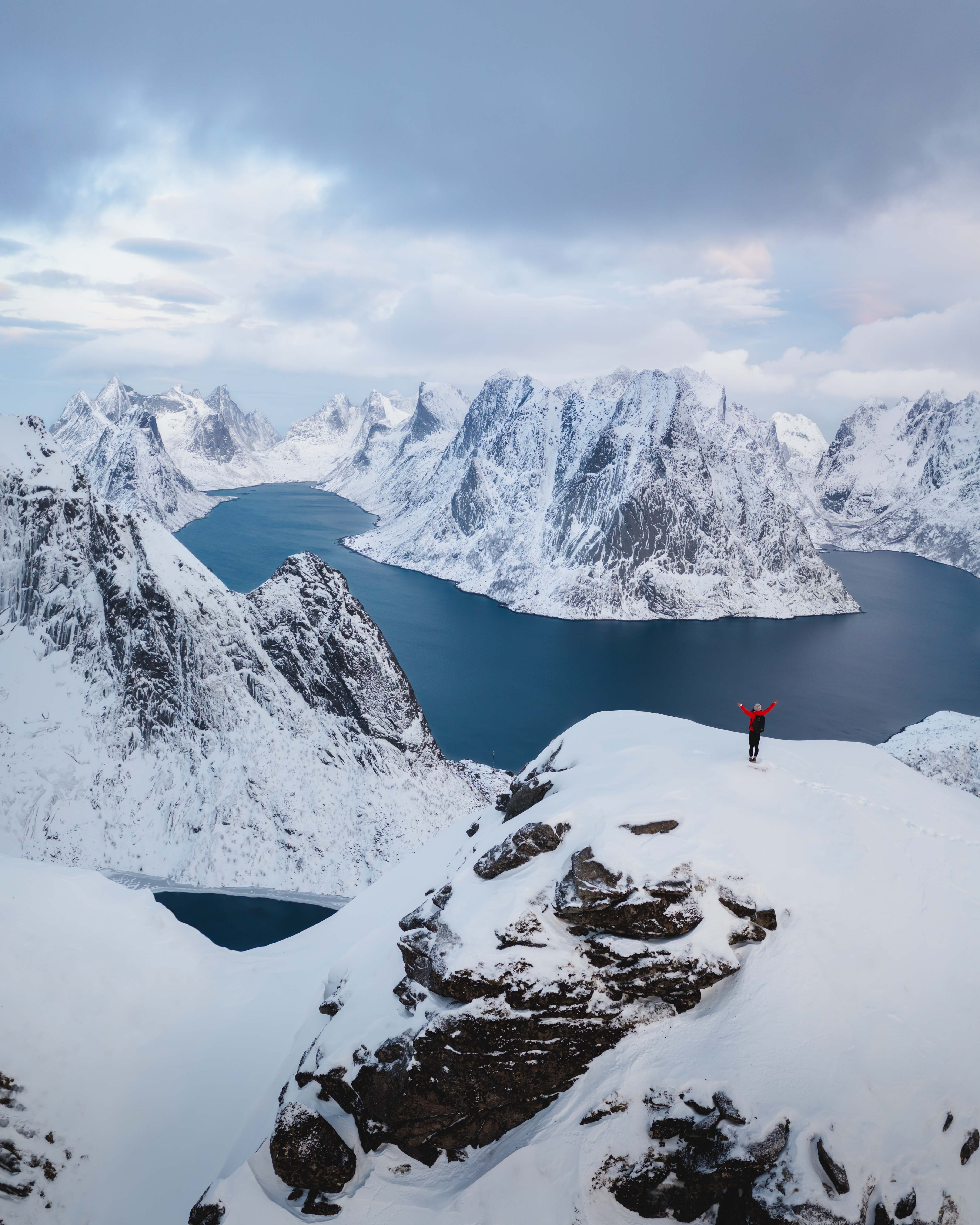
Want to opt for a snowy vacation and a winter trip to the Lofoten Islands? I got you covered. Lofoten is a series of islands (or an archipelago) in Norway. It has started to explode in popularity over the past few years, especially with photographers and outdoor lovers. I’ve always wanted to go to Lofoten, but I never thought my first time would be in the middle of the winter season. In January 2020, I spent three wonderful weeks exploring Norway, and Lofoten was one of my favorite spots!
In this blog post, you’ll find some tips, takeaways, and my favorite spots I visited.
When enjoying the outdoors, it’s essential to follow the Leave No Trace principles to help protect our natural landscapes for future generations. By packing out everything you bring, staying on designated trails, and respecting wildlife, we can all contribute to keeping nature pristine and beautiful. Learn more about LNT here.


How to get to the Lofoten Islands
There are many ways to get to Lofoten, but being that it is a series of islands, travel in general takes longer than expected. Here are a few options:
- Fly into the Harstad-Narvik airport, which is situated in the north of Lofoten. The airport is the cheaper option, but it requires a long drive to get to central Lofoten. For me, it took about 5 hours to drive to the Hattvika Lodge, which is an hour longer than expected. I had to drive cautiously as the roads are very curvy, the weather was all over the place, and I was looking out for elk! If you choose to fly into this airport, try to plan for the drive to be in the daylight. It would be the best option as it’s safer and there are incredible views to see along the way. I chose this option and recommend it for winter travel.
- Fly into Bodø and then take the ferry to Moskenes. This is a common route in the summer season, but not so common in the winter, as the ferry schedule is quite limited.
- Fly into Svolvær Airport or Leknes Airport. They are both in a more central area of Lofoten. Flying into these airports will cut down on driving, but flights and rental cars may be more expensive.
Driving in the Lofoten Islands
After we picked up our car and drove out of the airport, there was a moose on the road. We were ready for snowy roads, but not moose! So be aware.
As a general rule, drive slowly, give yourself extra time to get to where you need to go, and avoid suddenly braking.
From late November to March, the roads are usually covered in snow (and possibly ice). They can be bare, though, if the temperature rises and it rains. The weather in Lofoten is unpredictable, and you should be ready to get a mixed bag of weather.
Lofoten can get some crazy storms, so know when to stay in your accommodation until it’s safe.
Rental cars will provide you with a car with studded tires, but it would be a good thing to double-check.
In the winter, there is limited daylight, so be comfortable with driving in the dark.
Where to stay in the Lofoten Islands
My home base for this trip was the Hattvika Lodge. Let me tell you right off the bat that I don’t think I’ve ever experienced better hospitality than I did at the Hattvika Lodge. Kristian, the lovely owner, has rebuilt fisherman cottages to host guests from around the world.
I truly felt as though he provided me with a true Lofoten experience, which included staying in rustic cottages that were right on the water with fishermen’s boats outside the window, an incredible sauna to use every night, sharing local food with us, and even offering samples of Norwegian fish oil. Their property is a perfect spot if you want to explore more than just Reine.
You could also stay in the town of Reine if you want to focus on that one area.


What to wear in the Lofoten Islands
Lofoten is cold and windy, so make sure to wear (wool) base layers, a mid layer, and then an outer layer.
I’d recommend wearing a rain/wind shell or a parka if you get chilly easily. The temperature doesn’t drop to around -30C (like it does in Finland), but check out this post on what to wear in the cold.
Where to go in the Lofoten Islands
1. Hamnoy
The Hamnoy Bridge viewpoint is one of the most iconic Norwegian scenes—and I think it’s even more beautiful in the winter than it is in the summer.
Find a safe spot to pull over and park, then explore on foot.

2. Sakrisøya
Sakrisøya is another quintessential fishing village in Lofoten and another great stop on your road trip.
We just walked around and took some photos of the village. Instead of red homes like the previous village, this one has yellow, which is a perfect contrast to the snowy landscape.


3. Reine
Reine is quite possibly the most popular village in Lofoten—and for good reason. There are beautiful scenes every way you look. I spent an entire afternoon driving around, hopping in and out of the car to enjoy the views.
It’s a bit tricky finding parking along the road here, so I’d park in the parking lot by the marina and walk around.
This would also be a great place to stay, as it’s really central to multiple spots in this blog post.


4. Nusfjord
The quaint village of Nusfjord is often talked about as one of the oldest and best-preserved fishing villages in Norway.
There is a small entrance fee, but it’s worth it. I loved walking around and stopping at the bakery and little shops.

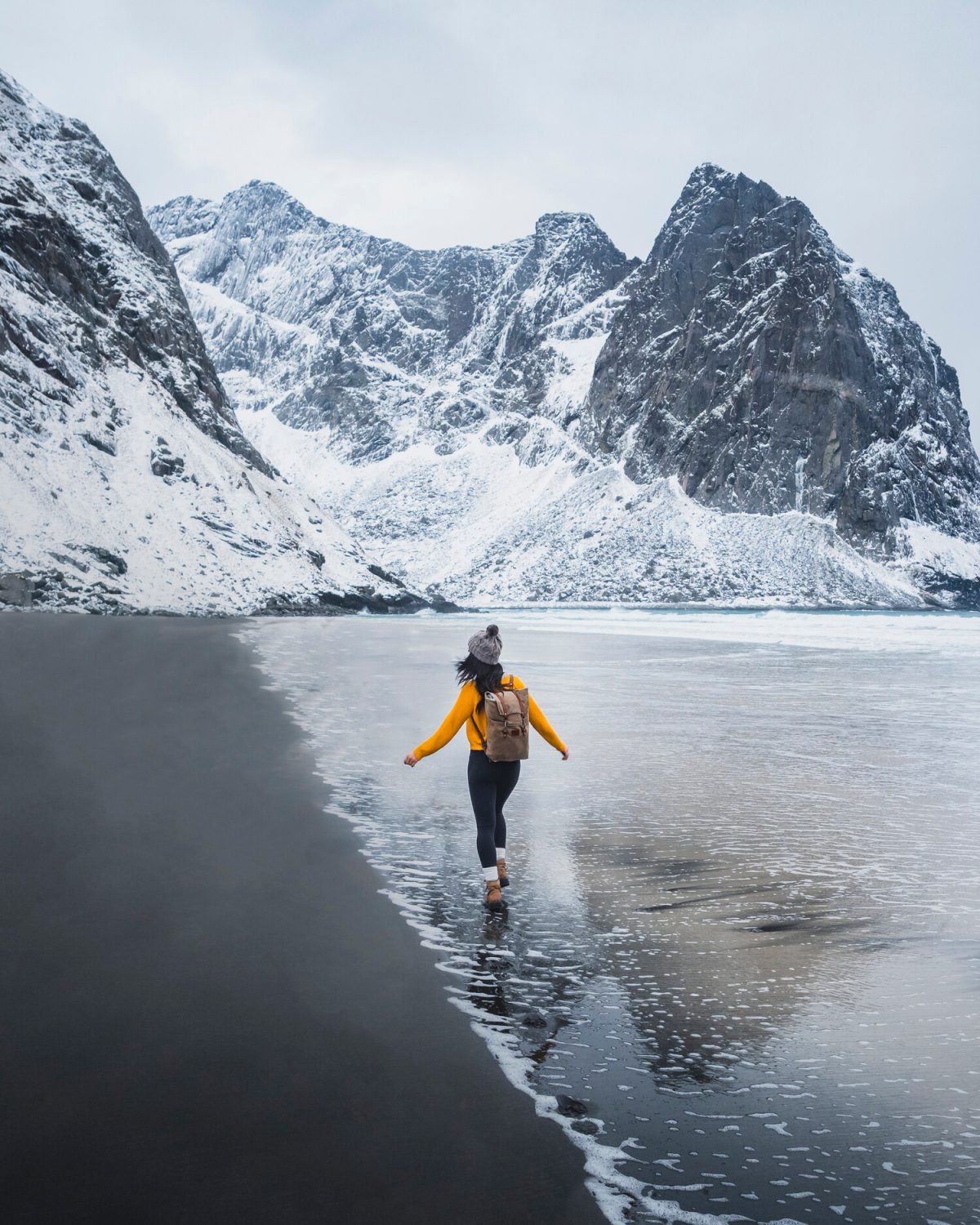
5. Kvalvika Beach
If you’re looking to stretch your legs a bit, the hike to Kvalvika Beach is perfect for you! It’s only about 2km total with 150m elevation gain (or 1.2 miles and 500ft). Here is more information on this trail.
In the winter, every hike takes longer than expected, and I believe this hike took me about 2 hours.
6. Northern Lights
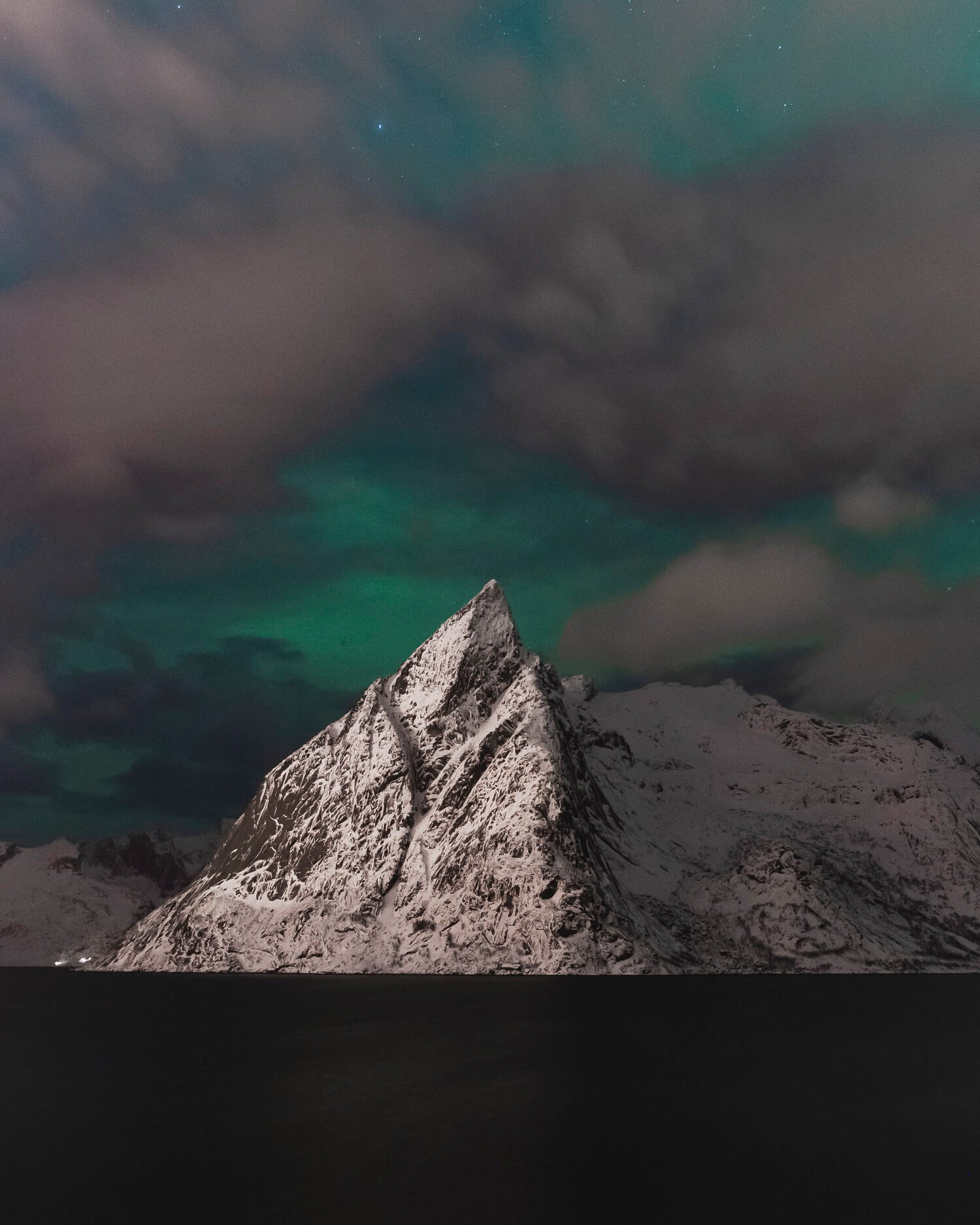
Along with luck, you need a few things to line up to experience the Northern Lights. You need a clear sky or a low amount of clouds, a strong Aurora, and complete darkness. If you check the weather, and it looks like it will be clear anytime the sky is dark. Then, head to a spot with no light pollution and look up.
In Lofoten, Uttakleiv and Haukland Beach are great options for low light pollution. Make sure you bundle up as it gets very cold shooting at night, always bring a headlamp, and remember to be patient as the Northern Lights move around the sky regularly.
From what I’ve researched, the best time to see them in Lofoten is August, October, February, and March. I took the photo below in Hamnoy, but wouldn’t recommend it as there was a bit too much light pollution.
7. Skagsanden Beach
Skagsanden Beach was a random beach that we just stumbled upon and fell in love with.
There were huge mountains all around the beach, and the water was an incredible blue color. It was crazy windy, so remember to bundle up!

8. Ryten Mountain
Ryten Mountain is another hike that is a must-do in Lofoten! It’s important to note that this one will take 3-5 hours, depending on the weather, which trailhead you start at, and how much snow there is.
It was crazy windy when I was up here, so remember that Norwegian weather is no joke. In terms of trailheads, there are two ways to get to the summit—one is from Kvalvika Beach (shown earlier in this post) and the other is from a separate trailhead.
I did this hike twice (due to weather) and hiked both trails during my trip, so I recommend hiking from the second option to get above the beach. It’s much more gradual and enjoyable! Check out this blog post for details on the trailheads and routes.

9. Reinebringen
Reinebringen is definitely the most popular hike in Lofoten. While it’s only 3km round trip, it is 500m of elevation gain (2 miles and 1700 feet), so it’s steep.
This trail can be very dangerous—especially in the winter season.
I can’t recommend this hike enough, but I urge you to read reviews, ask locals, and/or reach out to others who have done the hike to find out the current conditions.
If you want to be able to do this trail on your trip and be safe, think about visiting in late fall, like November.


My takeaways
- Lofoten is much less busy in the winter season. Some businesses were closed for the winter, but these closures did not affect me at all.
- During the summer months, many of the Airbnbs, hotels, and hostels are fully booked. In the winter season, a trip doesn’t require as much planning, as not as many people visit, which allows for more accommodation options.
- Keep in mind that the weather is very unpredictable during the winter in Lofoten. The weather changes quickly, so even if there is a storm, it may not be like that all day. This is all part of the adventure!
- Rental cars (which are pretty much necessary) and flights seem to be a bit cheaper in the winter season.

- The days from late November to early January are very short with little daylight. I’d say a good time to go to Lofoten for the winter is late January-March. The days become longer, there are more sunny days, and less precipitation.
- Parking in Lofoten is very limited (especially in Reine). With fewer cars on the road in the winter, I was able to pull over (safely) and explore at almost any time. I’m not so sure I could’ve done this as easily in the summer.
- I experienced very heavy winds while hiking, so please be careful and know your limits. Always pack extra layers, water, snacks, gloves, sunglasses (they help if the wind picks up and snow is getting tossed in your eyes), a windproof jacket, and a GPS.
- While I could spend months solely in Lofoten, I suggest also exploring different areas of Norway, such as Senja or Tromsø, especially in the winter.
There are affiliate links in this post, Best Fall Photography Spots in the Italian Dolomites, and I may earn a small commission if you choose to purchase an item (at no additional cost to you). These funds go right back into creating content just like this and supporting my small business. If you do choose to purchase something, thank you for your support!
Photos are shot by me, Justin Kauffman, Luke Stackpoole, Travis Kauffman, and Kelsey J.
Wow so beautiful.. Thank You…
Thanks for being here, Richie!
I hope I will have a chance to get there. The place is so amazing. Thank you for sharing insights into this lovely place!
Thank you for reading 🙂
In recent years, the Lofoten Islands have become increasingly commercialized. There are more and more buildings that devastate the amazing views.
Hey thanks for the geat post. Can I ask why a car would be necessary? Seems that you moved around quite a lot and I’m just wondering what other options there would be to see the sights listed above. Thanks 🙂
A lot of these places are not walking distance from each other. You could potentially get away without a car if you got a bus to Reine and stayed in that small village.
Hi Angela, beautiful pics and travel tips for Lofoten Island. Can’t wait to visit there in winter.
I am excited for you!
Couldn’t have, not “couldn’t of.”
Oops. Thank you!
Nice post, Thank you for sharing
Thanks for reading!